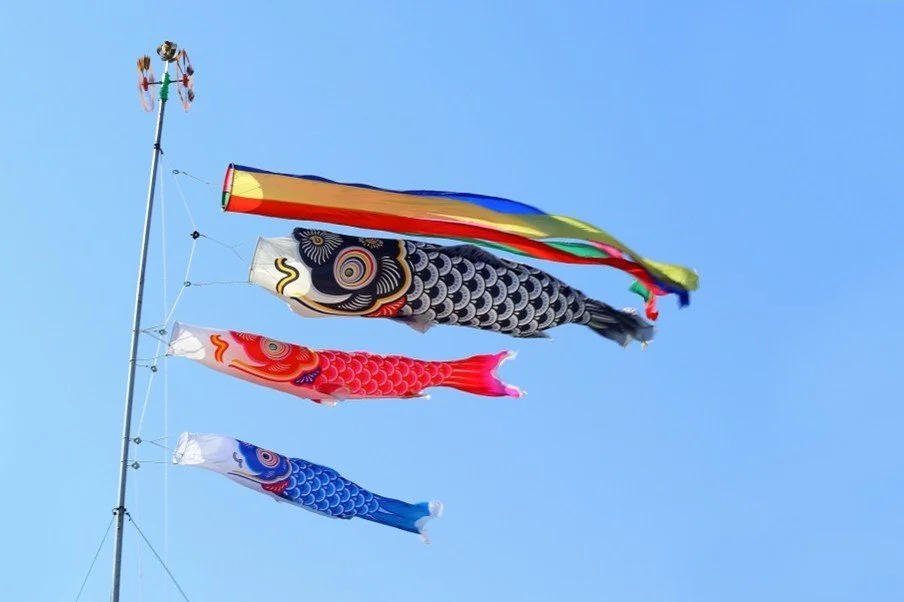
Windsocks for Children’s day in Japan and five elements
You may have seen a fish‑shaped windsock flying in the sky in the United States. In Japanese, it is called koi‑nobori. The fish depicted is a carp. Why a carp? According to a Chinese folk tale, a carp that swam up a series of powerful waterfalls reached the top and transformed into a dragon. Because of this story, the carp—and the dragon it becomes—are symbols of strength and good fortune.
In Japan, carp windsocks are flown only around May 5th. Parents who have a first son display these carp windsocks to wish that he will grow strong, like a carp that swims against difficulty and reaches the top. Why boys? Until recently, May 5th was called Boys’ Day. It is now called Children’s Day and is a national holiday.
A set of koi‑nobori includes a streamer at the top and carp representing the parents and the first son. Today, the colors of the streamer vary, but traditionally it contains five colors from the five natural elements: blue or green (wood), red (fire), yellow (earth), white (metal), and black (water). The black carp represents the father, the red carp represents the mother, and the blue carp represents the first son. If more sons are born, additional carp are added.
This ancient practice has continued to the present day as an expression of parents’ wishes, and it will be carried forward to future generations.